On keeping pace with the moon.
I'm doing the dishes when José González comes on. I haven't heard his voice in years, but within the first few notes, I'm back in my twenties, living on Broderick Street in San Francisco, at the top of an ornate, three-story Victorian walk-up.
There were only six apartments in the building. Directly below mine, I discovered, lived a Spaniard named Gerardo.
We met at a debaucherous party my roommate and I hosted, a night deserving of its own story, involving dancing, miniature cupcakes hurled at the walls, and tampons left aggressively in the bathtub. I don't remember exactly how Gerardo and I found each other in the midst of all this, but sometime afterward, he invited me downstairs.
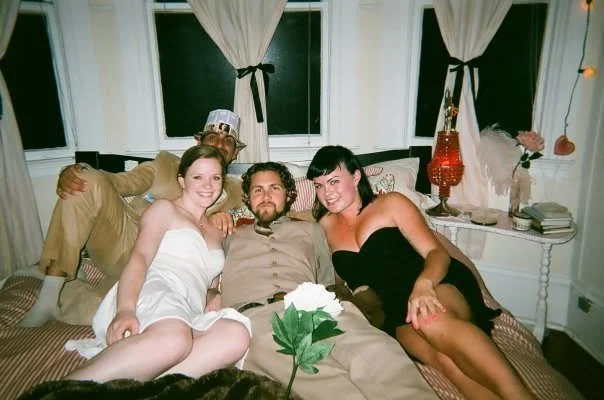
THE party. (Gerardo, not pictured)
It was there that he introduced me to José González.
Nearly every song on Veneer is crystallized around one or two evenings in Gerardo's apartment. He spoke German, as did I. I remember him reading poetry aloud to me, in both Spanish and German. I remember the way he touched my fingernails, tenderly, almost absently, with an intimate attentiveness I hadn't encountered much in my early twenties. I remember the feeling of being regarded in this way, of having someone's attention without having to do anything to hold it.
Gerardo seemed to have stepped out of a Salinger novel. There was something vaguely European and intellectual about the whole affair: the poetry, the music, the apartment downstairs, the extraordinary familiarity of someone touching my fingernails. It was precisely the sort of romance my twenty-something self was inclined to mythologize.
And mythologize it I did.
Almost immediately after we first connected, I learned that he had a girlfriend who'd been living abroad. She returned to San Francisco, moved into his apartment, discovered my existence, and began stalking me at the neighborhood bar where I worked, just around the corner.
So much for romance.
And yet, twenty years later, none of that is what I remember first when I hear José González. I remember the couch where we draped ourselves along the wall of Gerardo's apartment. The poetry. His hands on mine. The strange and exquisite feeling of being young and having an entire evening to spend in someone else's company, unconcerned with time or the care of anyone else.
I'm standing at my kitchen sink now, fifteen or so days into a long stretch of solo parenting. There are dishes to wash, meals to make, children to tend to, an endless succession of small domestic obligations that seem to regenerate the moment I finish them. And here, in the middle of it all, is this music, pulling some decades-old version of me into the room.
I'm astonished, as I always am, by the way music does this. Not simply reminding us of something, but returning us to it. The memory arrives in the body before the mind has even had time to identify it. And the memories contain memories. First, the fingernails. Then, my inadvertent participation in a betrayal of his girlfriend. First, he was a living legend of sorts, and then an insecure scoundrel, seeking the intimate attention of other women when he'd already promised himself to another.
I marinate in the intensity of that ricochet. I've lived there my whole life—volleying between extremes, wanting to categorize something as good or bad. Make it simple. The things most intimate to me, I somehow want to be cleanly categorized.
But somewhere in my mind, Michael's voice says, There are no problems, only opportunities.
These days, I can often land there, in gratitude for whatever shows up. I can eventually see the goodness in whatever feels interminably bad in the moment.
Challenging this perception was the beginning of our current school year, overshadowed by an extremely unglamorous battle with hemorrhoids.
Something set off my gut, which made my butt explode, which caused nonstop, searing, radiating pain that made me sick to my stomach. I began guarding my entire pelvic area, eventually inflaming it to the point that I felt a near-constant, burning need to pee. All of which prevented me from sleeping for more than forty minutes at a time. For over three weeks.
BAD.
I felt so heavy in my pain, so desperate for solutions, so deeply alone and hopeless, and also weirdly ostracized by what a socially unacceptable topic of conversation it was. I was wincing and occasionally weeping my way through the school days, equal parts totally exhausted and afraid to go to sleep because of how much louder the pain felt through those sleepless nights.
Bad, bad, bad.
And I felt so stuck in that badness. I floundered through my spiritual practices and then, alternately, medicine and my near-total lack of healthcare, throwing spaghetti at the wall in a desperate attempt to get myself through it.
Eventually, I gave up.
I stopped trying to fix it, cure it, change it, or be virtuous enough that it would disappear. I stopped littering my body with a combination of pharmaceuticals and internal vitriol. I let myself accept that this was what was happening, that I was in pain, and that I didn't have to make something meaningful out of it.
I rested. I sat with the pain. I didn't go to work. I watched TV and cried and sat in the bathtub for hours throughout the hottest days of the year, trusting that my body was doing whatever it needed to do.
And, eventually, it shifted.
At the culmination of this journey, just as the wheel turned, we had an uncharacteristic trip to Disneyland planned. I'd sworn I'd never go, but some of our dearest friends had invited us for a day trip, and with them, and them only, my answer was yes.
And yet again, I found myself anticipating the experience in extremes. Either this adventure would erase the suffering of several miserable weeks with the promise of the Happiest Place on Earth, or I'd loathe every minute of it.
Too much stimulation, too many transitions, too many people, too much noise. Too much of everything that rattles my slow and quiet internal world.
As the day approached, I found myself wishing Disneyland would burn down. I found myself wishing everyone's stuffy noses would turn into a tidal wave of illness that kept us homebound. My anxiety about what was to come was the most extreme thing of all.
And when the day came, with Disneyland and our relative health both very much still intact, we arrived.
The girls, as it turns out, are roller coaster fanatics. They don't care about or recognize almost any Disney characters. They found lines longer than a few minutes insufferable and the intricate details of nearly everything around them completely magical. There was an abundance of joy between them and their friends, and after ten hours and nearly ten miles of walking, they were kept afloat by churros, root beer floats, and the hum of magic that truly is everywhere in the air at Disneyland.
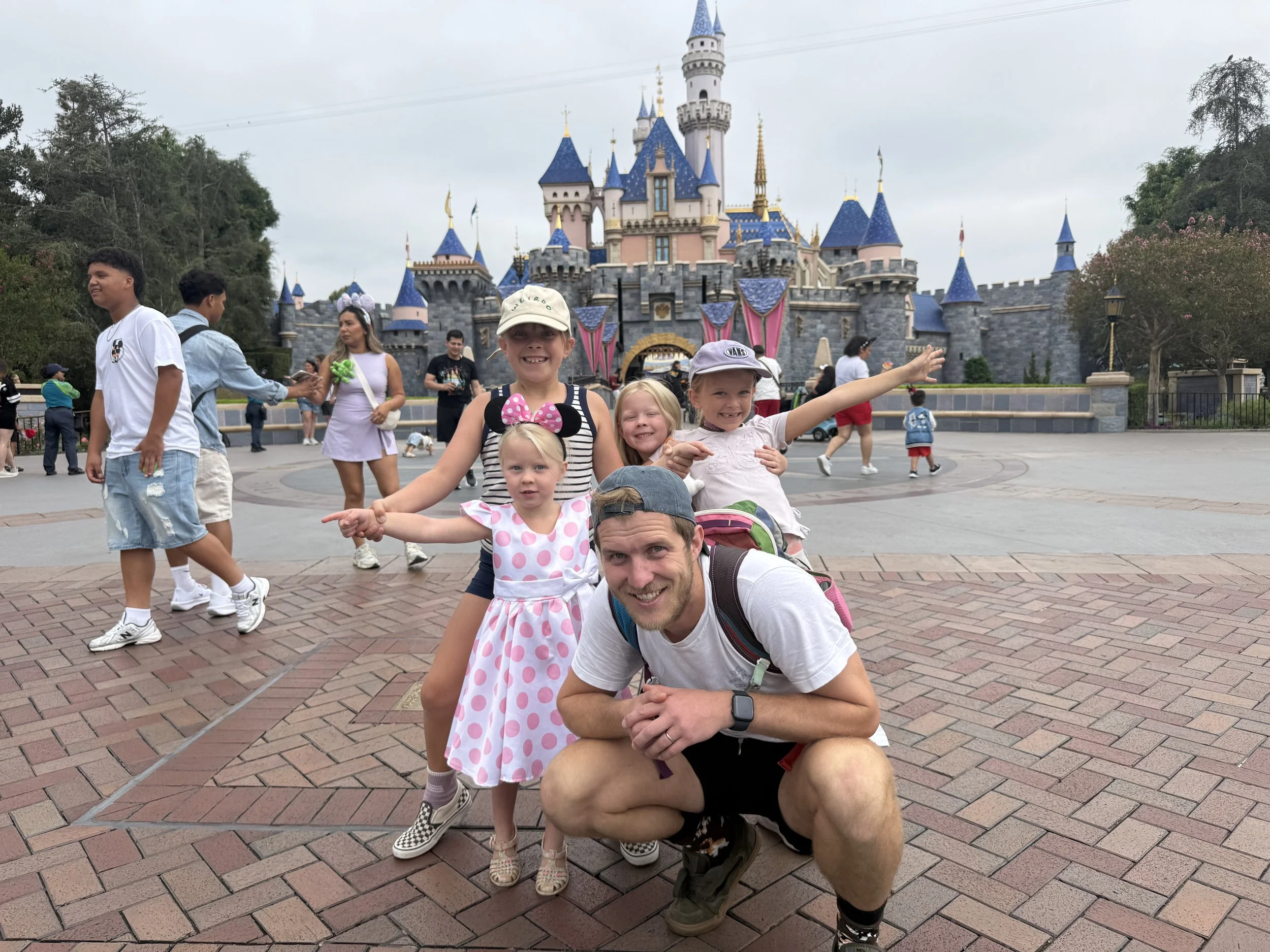
I was immediately and unrelentingly overstimulated and exhausted, and also profoundly relieved to have to make zero decisions about anything, because our beloved friends simply toted us around from one ride and experience to the next.
We walked out beaming and exhausted, and a still-stubborn part of me wanted to call it, remember it as, a perfect day.
Somewhere on the 405, Bonnie began having what can only be described as an exorcism, screaming in pain because her legs hurt from so much walking. She insisted that I both rub them and keep driving so she could get home, and the sheer absurdity of the moment leveled me out once again.
It's as though my brain is participating in a constant hunt, my mind shouting hot! or cold! in response to every given moment.
What if it's just warm? What if the temperature is constantly fluctuating? What if it's all swirled together and this is life? Not one long smear of Instagram-reel happiness, nor one melancholy saga of suffering, but a tumble of constant highs and lows. What if the real suffering is in my attachment to holding on to any of it?
Somehow, I managed to rub Bonnie's legs while I drove. One hand reaching into the back seat, one hand on the wheel. The split life, the split roles, the split woman. The multitasker. The duality. The tenderness and the pain.
Eventually, she fell asleep.
I spent the rest of the ride home alongside a vibrant crescent moon, listening to Laura Veirs. Her album Saltbreaks belongs to the beginning of my relationship with Nic. Another kind of longing, deeper than Gerardo. One of transformation, of changing tides.
I was dropping the girls at his house that evening and found myself thinking of him. Of these babies we'd birthed, this life we'd dreamed of, the way it had warped and wefted into something neither of us could have imagined.
I wasn't sad. And I wasn't happy. I was just riding alongside the moon, feeling the aching stretch of experience. How we change in ways we could never expect.
There is something about driving that allows you to be a person between moments, suspended in time between realities. The girls were asleep behind me. The day was over, but I hadn't quite arrived at the next thing. There was nothing left to orchestrate, no one to entertain, no immediate demand to meet. Just the road, the music and its memories, and this triumphant little moon keeping pace with us.
I watched it through the windshield, appearing and disappearing as the road curved, and thought about how many versions of myself had traveled beneath it. The young woman listening to José González in a stranger's apartment. The woman falling in love with Nic. The mother of two tiny babies. The woman who had eventually left the life she'd imagined for herself and was now driving those babies, not so tiny anymore, to their father's house.
All of them somehow here, in the car, beneath the same moon.
When we got to his house, the girls sleepily stumbled upstairs, and I kissed them a million times in their daddy's-house beds. It struck me that this was the first time in probably over four years that Nic and I had put our babies to bed together.
At one point, he put his hand on my lower back.
It didn't feel strange to me, but I did notice it. Today, it reminds me of Gerardo touching my fingernails. How these tiny moments—almost banal gestures of physical touch—anchor my human experience. What becomes abstract in memory and thought is made tangible when another human makes contact with me. It's no longer good or bad. It's music and temperature and touch.
A meditation I listened to recently invited me to feel what it actually feels like to be in my body. Not to live within the story I've created about it, or my imagination of what it must be like to inhabit it, but to actually be there. To feel it.
The idea startled me. How often am I living beneath the albatross of my own mind? Under the thick weight of stories that have somehow calcified into reality? How does my body actually feel?
It was surprisingly difficult to access.
Often, my body feels horrible. I'm still tired in my bones most days. Occasionally my butthole is falling out, my gut is churning, I can't sleep, and I'm going crazy with the relentless demands of life. But surely there are pauses in which all is well. Moments when I feel fine, or even happy and whole. Do I notice those, too?
Rarely, it seems. I've become so accustomed to monitoring and assessing myself, trying to fix and optimize, that even healing has somehow become an aggression against myself. An impatience. An insistence. An intolerance.
I recently decided to begin hormone replacement therapy. It felt deeply aligned to give my body back some of the regulating hormones that seemed to be waning. I met with a progressive nurse practitioner in private practice who specializes in hormone therapy.
Her office was less a medical establishment than a magazine-worthy home, complete with a fluffy dog greeting me at the door and a glass of slightly bitter lemonade waiting at my seat, a sprig of lavender beside the cup. It was all so precious, so personal.
She listened to my story in detail. Not just my lab work, but my experience. She recommended starting estrogen right away.
And then, somewhere in our conversation, sprinkled among my hopes for a more robust life, she mentioned the possibility of weight-loss drugs.
It pricked at me, but I tried to overlook it.
Everything in my system already says: Body is BAD.
Bad bad bad bad bad BAD.
Not everyone's body. Mine.
This body is bad. You have to change it. You have to cover it. You are too much and too big.
Those feelings flickered up, and I shut them down almost immediately. I could continue on my HRT journey. I could feel awake and alive again.
GOOD.
Until she followed up by email.
She warned me about the perils of visceral fat. She suggested I buy a HUME scale to monitor my body composition.
And all I heard was that I was a failure.
Here was a woman who had just listened to my story, who knew so little of my history with food or the long and complicated journey I'd taken to inhabit this body, and somehow I felt that she'd looked at me and decided I needed to be smaller.
I had come to her hoping to feel more alive. And suddenly, I felt myself being returned to a familiar and exhausting project: the improvement of my own body.
I've spent at least a decade healing my relationship with food. Learning to eat real meals, to nurture myself, to recognize what lands well in my body. I've spent a decade coming home to this body, allowing it to move and live and express itself. Learning to trust what I feel. My intuition. My bodily knowing.
I love to write and read and think, but above all, I am an embodied creature. I am not the giant head I seem to carry around on a physical form.
I am an animal, full of knowing.
And yet, almost immediately, I spiraled.
I fell headlong into an ancient wound, one I've spent so much of my adult life trying to tend to, understand, excavate, heal. A wound in which there is no ambiguity, no nuance, no room for the complicated and contradictory experience of being human. There is only BAD.
My body is bad. Too big. Too much. Evidence of some failure of discipline or restraint or worthiness. It doesn't matter how many years I've spent learning to nourish it, how many miles I've walked or danced, how many babies it's grown, how much pain it's endured, how much pleasure it's known. None of that seems to count once I've fallen into this place.
And suddenly I was thinking about weight-loss drugs all the time. Wondering whether I should take them, whether I wanted to take them, whether wanting to take them meant I'd betrayed some essential part of myself. Whether refusing them was an act of self-love or just another way of clinging to an identity I'd worked so hard to construct. Whether my hunger was something to honor or something to silence.
Good. Bad. Good. Bad.
There I was again.
I had walked into that lovely little office hoping to feel more alive in my body, and somehow emerged more preoccupied than ever with the question of whether my body was acceptable. I had wanted presence and found myself back in assessment. I had wanted attunement and found myself calculating, scrutinizing, negotiating with some imagined future version of myself who might finally be allowed to feel at home.
I know this place so well. I can make a project of almost anything. My health. My motherhood. My relationships. My spiritual practice. Even my capacity to surrender becomes something I can do well or badly.
I can turn healing into another standard against which I fail.
And I wonder how much of my life I've spent postponing the experience of actually living it. Imagining that if I can just get healthy enough, rested enough, thin enough, regulated enough, healed enough, I'll finally arrive at some state of uncomplicated presence. That I'll have resolved all the things that make inhabiting this body so difficult, and then I can get on with the business of living in it.
But the life itself has been happening all along.
The following week at school, I randomly pulled a picture book off my shelf to read to my friends. It’s called The Moon Is Going to Addy's House.
It's a simple book, almost entirely composed of these extraordinary, intricate collages. There are very few words. Two little girls and their family are driving home, and through the windows of their car, the moon follows them.
There it was again.
The same moon I'd driven alongside on the way home from Disneyland. The one that had accompanied me through all that longing and remembering, as I carried our sleeping children from one life to another.
And here I was, sitting with a group of preschoolers, turning the pages of a book I'd happened to pull off the shelf, watching the moon follow another little girl home.
I don't know that I need to make anything more of it. Maybe, for a moment, I can set down all the stories. The assessment. The endless sorting of experience into good and bad.
Maybe I can just nestle my hips into the late-summer dust beneath the eucalyptus trees and read a quiet book to some babies. One little hand resting on my shoulder. Another child sitting in my lap.
Touching me into presence.
I think I just want to look.