On keeping pace with the moon.

I'm doing the dishes when José González comes on. I haven't heard his voice in years, but within the first few notes, I'm back in my twenties, living on Broderick Street in San Francisco, at the top of an ornate, three-story Victorian walk-up.

There were only six apartments in the building. Directly below mine, I discovered, lived a Spaniard named Gerardo.

We met at a debaucherous party my roommate and I hosted, a night deserving of its own story, involving dancing, miniature cupcakes hurled at the walls, and tampons left aggressively in the bathtub. I don't remember exactly how Gerardo and I found each other in the midst of all this, but sometime afterward, he invited me downstairs.
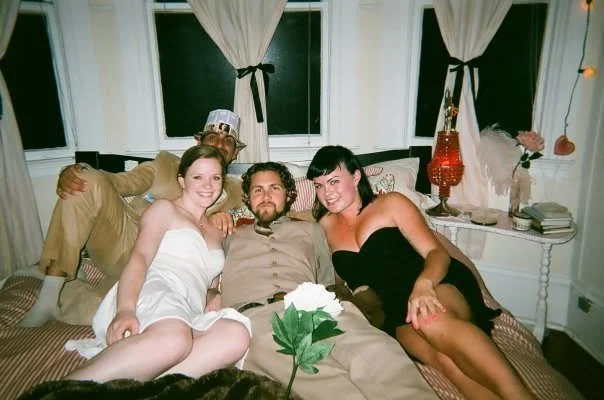
THE party. (Gerardo, not pictured)

It was there that he introduced me to José González.

Nearly every song on Veneer is crystallized around one or two evenings in Gerardo's apartment. He spoke German, as did I. I remember him reading poetry aloud to me, in both Spanish and German. I remember the way he touched my fingernails, tenderly, almost absently, with an intimate attentiveness I hadn't encountered much in my early twenties. I remember the feeling of being regarded in this way, of having someone's attention without having to do anything to hold it.

Gerardo seemed to have stepped out of a Salinger novel. There was something vaguely European and intellectual about the whole affair: the poetry, the music, the apartment downstairs, the extraordinary familiarity of someone touching my fingernails. It was precisely the sort of romance my twenty-something self was inclined to mythologize.

And mythologize it I did.

Almost immediately after we first connected, I learned that he had a girlfriend who'd been living abroad. She returned to San Francisco, moved into his apartment, discovered my existence, and began stalking me at the neighborhood bar where I worked, just around the corner.

So much for romance.

And yet, twenty years later, none of that is what I remember first when I hear José González. I remember the couch where we draped ourselves along the wall of Gerardo's apartment. The poetry. His hands on mine. The strange and exquisite feeling of being young and having an entire evening to spend in someone else's company, unconcerned with time or the care of anyone else.

I'm standing at my kitchen sink now, fifteen or so days into a long stretch of solo parenting. There are dishes to wash, meals to make, children to tend to, an endless succession of small domestic obligations that seem to regenerate the moment I finish them. And here, in the middle of it all, is this music, pulling some decades-old version of me into the room.

I'm astonished, as I always am, by the way music does this. Not simply reminding us of something, but returning us to it. The memory arrives in the body before the mind has even had time to identify it. And the memories contain memories. First, the fingernails. Then, my inadvertent participation in a betrayal of his girlfriend. First, he was a living legend of sorts, and then an insecure scoundrel, seeking the intimate attention of other women when he'd already promised himself to another.

I marinate in the intensity of that ricochet. I've lived there my whole life—volleying between extremes, wanting to categorize something as good or bad. Make it simple. The things most intimate to me, I somehow want to be cleanly categorized.

But somewhere in my mind, Michael's voice says, There are no problems, only opportunities.

These days, I can often land there, in gratitude for whatever shows up. I can eventually see the goodness in whatever feels interminably bad in the moment.

Challenging this perception was the beginning of our current school year, overshadowed by an extremely unglamorous battle with hemorrhoids.

Something set off my gut, which made my butt explode, which caused nonstop, searing, radiating pain that made me sick to my stomach. I began guarding my entire pelvic area, eventually inflaming it to the point that I felt a near-constant, burning need to pee. All of which prevented me from sleeping for more than forty minutes at a time. For over three weeks.

BAD.

I felt so heavy in my pain, so desperate for solutions, so deeply alone and hopeless, and also weirdly ostracized by what a socially unacceptable topic of conversation it was. I was wincing and occasionally weeping my way through the school days, equal parts totally exhausted and afraid to go to sleep because of how much louder the pain felt through those sleepless nights.

Bad, bad, bad.

And I felt so stuck in that badness. I floundered through my spiritual practices and then, alternately, medicine and my near-total lack of healthcare, throwing spaghetti at the wall in a desperate attempt to get myself through it.

Eventually, I gave up.

I stopped trying to fix it, cure it, change it, or be virtuous enough that it would disappear. I stopped littering my body with a combination of pharmaceuticals and internal vitriol. I let myself accept that this was what was happening, that I was in pain, and that I didn't have to make something meaningful out of it.

I rested. I sat with the pain. I didn't go to work. I watched TV and cried and sat in the bathtub for hours throughout the hottest days of the year, trusting that my body was doing whatever it needed to do.

And, eventually, it shifted.

At the culmination of this journey, just as the wheel turned, we had an uncharacteristic trip to Disneyland planned. I'd sworn I'd never go, but some of our dearest friends had invited us for a day trip, and with them, and them only, my answer was yes.

And yet again, I found myself anticipating the experience in extremes. Either this adventure would erase the suffering of several miserable weeks with the promise of the Happiest Place on Earth, or I'd loathe every minute of it.

Too much stimulation, too many transitions, too many people, too much noise. Too much of everything that rattles my slow and quiet internal world.

As the day approached, I found myself wishing Disneyland would burn down. I found myself wishing everyone's stuffy noses would turn into a tidal wave of illness that kept us homebound. My anxiety about what was to come was the most extreme thing of all.

And when the day came, with Disneyland and our relative health both very much still intact, we arrived.

The girls, as it turns out, are roller coaster fanatics. They don't care about or recognize almost any Disney characters. They found lines longer than a few minutes insufferable and the intricate details of nearly everything around them completely magical. There was an abundance of joy between them and their friends, and after ten hours and nearly ten miles of walking, they were kept afloat by churros, root beer floats, and the hum of magic that truly is everywhere in the air at Disneyland.
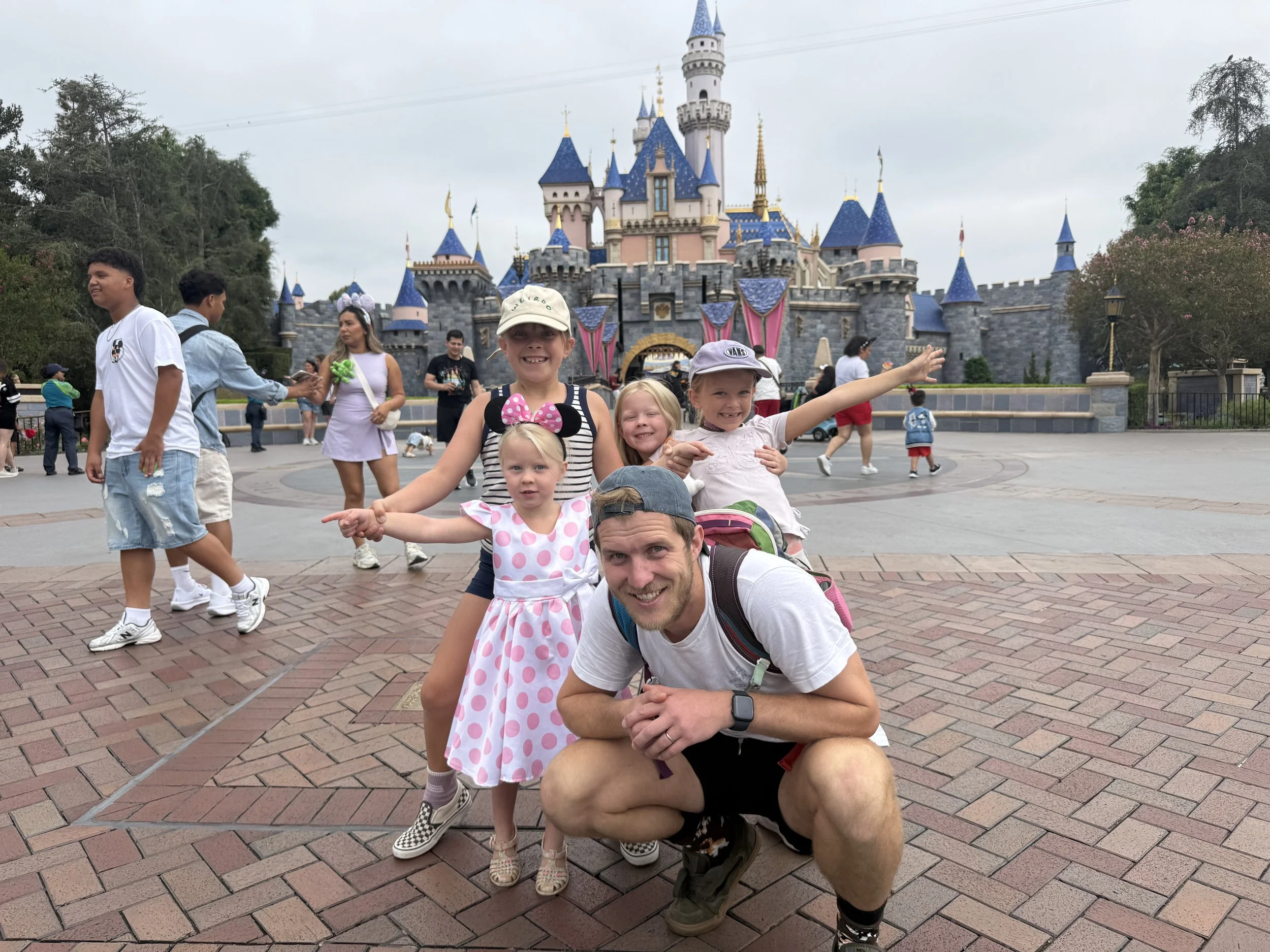
I was immediately and unrelentingly overstimulated and exhausted, and also profoundly relieved to have to make zero decisions about anything, because our beloved friends simply toted us around from one ride and experience to the next.

We walked out beaming and exhausted, and a still-stubborn part of me wanted to call it, remember it as, a perfect day.

Somewhere on the 405, Bonnie began having what can only be described as an exorcism, screaming in pain because her legs hurt from so much walking. She insisted that I both rub them and keep driving so she could get home, and the sheer absurdity of the moment leveled me out once again.

It's as though my brain is participating in a constant hunt, my mind shouting hot! or cold! in response to every given moment.

What if it's just warm? What if the temperature is constantly fluctuating? What if it's all swirled together and this is life? Not one long smear of Instagram-reel happiness, nor one melancholy saga of suffering, but a tumble of constant highs and lows. What if the real suffering is in my attachment to holding on to any of it?

Somehow, I managed to rub Bonnie's legs while I drove. One hand reaching into the back seat, one hand on the wheel. The split life, the split roles, the split woman. The multitasker. The duality. The tenderness and the pain.

Eventually, she fell asleep.

I spent the rest of the ride home alongside a vibrant crescent moon, listening to Laura Veirs. Her album Saltbreaks belongs to the beginning of my relationship with Nic. Another kind of longing, deeper than Gerardo. One of transformation, of changing tides.

I was dropping the girls at his house that evening and found myself thinking of him. Of these babies we'd birthed, this life we'd dreamed of, the way it had warped and wefted into something neither of us could have imagined.

I wasn't sad. And I wasn't happy. I was just riding alongside the moon, feeling the aching stretch of experience. How we change in ways we could never expect.

There is something about driving that allows you to be a person between moments, suspended in time between realities. The girls were asleep behind me. The day was over, but I hadn't quite arrived at the next thing. There was nothing left to orchestrate, no one to entertain, no immediate demand to meet. Just the road, the music and its memories, and this triumphant little moon keeping pace with us.

I watched it through the windshield, appearing and disappearing as the road curved, and thought about how many versions of myself had traveled beneath it. The young woman listening to José González in a stranger's apartment. The woman falling in love with Nic. The mother of two tiny babies. The woman who had eventually left the life she'd imagined for herself and was now driving those babies, not so tiny anymore, to their father's house.

All of them somehow here, in the car, beneath the same moon.

When we got to his house, the girls sleepily stumbled upstairs, and I kissed them a million times in their daddy's-house beds. It struck me that this was the first time in probably over four years that Nic and I had put our babies to bed together.

At one point, he put his hand on my lower back.

It didn't feel strange to me, but I did notice it. Today, it reminds me of Gerardo touching my fingernails. How these tiny moments—almost banal gestures of physical touch—anchor my human experience. What becomes abstract in memory and thought is made tangible when another human makes contact with me. It's no longer good or bad. It's music and temperature and touch.

A meditation I listened to recently invited me to feel what it actually feels like to be in my body. Not to live within the story I've created about it, or my imagination of what it must be like to inhabit it, but to actually be there. To feel it.

The idea startled me. How often am I living beneath the albatross of my own mind? Under the thick weight of stories that have somehow calcified into reality? How does my body actually feel?

It was surprisingly difficult to access.

Often, my body feels horrible. I'm still tired in my bones most days. Occasionally my butthole is falling out, my gut is churning, I can't sleep, and I'm going crazy with the relentless demands of life. But surely there are pauses in which all is well. Moments when I feel fine, or even happy and whole. Do I notice those, too?

Rarely, it seems. I've become so accustomed to monitoring and assessing myself, trying to fix and optimize, that even healing has somehow become an aggression against myself. An impatience. An insistence. An intolerance.

I recently decided to begin hormone replacement therapy. It felt deeply aligned to give my body back some of the regulating hormones that seemed to be waning. I met with a progressive nurse practitioner in private practice who specializes in hormone therapy.

Her office was less a medical establishment than a magazine-worthy home, complete with a fluffy dog greeting me at the door and a glass of slightly bitter lemonade waiting at my seat, a sprig of lavender beside the cup. It was all so precious, so personal.

She listened to my story in detail. Not just my lab work, but my experience. She recommended starting estrogen right away.

And then, somewhere in our conversation, sprinkled among my hopes for a more robust life, she mentioned the possibility of weight-loss drugs.

It pricked at me, but I tried to overlook it.

Everything in my system already says: Body is BAD.

Bad bad bad bad bad BAD.

Not everyone's body. Mine.

This body is bad. You have to change it. You have to cover it. You are too much and too big.

Those feelings flickered up, and I shut them down almost immediately. I could continue on my HRT journey. I could feel awake and alive again.

GOOD.

Until she followed up by email.

She warned me about the perils of visceral fat. She suggested I buy a HUME scale to monitor my body composition.

And all I heard was that I was a failure.

Here was a woman who had just listened to my story, who knew so little of my history with food or the long and complicated journey I'd taken to inhabit this body, and somehow I felt that she'd looked at me and decided I needed to be smaller.

I had come to her hoping to feel more alive. And suddenly, I felt myself being returned to a familiar and exhausting project: the improvement of my own body.

I've spent at least a decade healing my relationship with food. Learning to eat real meals, to nurture myself, to recognize what lands well in my body. I've spent a decade coming home to this body, allowing it to move and live and express itself. Learning to trust what I feel. My intuition. My bodily knowing.

I love to write and read and think, but above all, I am an embodied creature. I am not the giant head I seem to carry around on a physical form.

I am an animal, full of knowing.

And yet, almost immediately, I spiraled.

I fell headlong into an ancient wound, one I've spent so much of my adult life trying to tend to, understand, excavate, heal. A wound in which there is no ambiguity, no nuance, no room for the complicated and contradictory experience of being human. There is only BAD.

My body is bad. Too big. Too much. Evidence of some failure of discipline or restraint or worthiness. It doesn't matter how many years I've spent learning to nourish it, how many miles I've walked or danced, how many babies it's grown, how much pain it's endured, how much pleasure it's known. None of that seems to count once I've fallen into this place.

And suddenly I was thinking about weight-loss drugs all the time. Wondering whether I should take them, whether I wanted to take them, whether wanting to take them meant I'd betrayed some essential part of myself. Whether refusing them was an act of self-love or just another way of clinging to an identity I'd worked so hard to construct. Whether my hunger was something to honor or something to silence.

Good. Bad. Good. Bad.

There I was again.

I had walked into that lovely little office hoping to feel more alive in my body, and somehow emerged more preoccupied than ever with the question of whether my body was acceptable. I had wanted presence and found myself back in assessment. I had wanted attunement and found myself calculating, scrutinizing, negotiating with some imagined future version of myself who might finally be allowed to feel at home.

I know this place so well. I can make a project of almost anything. My health. My motherhood. My relationships. My spiritual practice. Even my capacity to surrender becomes something I can do well or badly.

I can turn healing into another standard against which I fail.

And I wonder how much of my life I've spent postponing the experience of actually living it. Imagining that if I can just get healthy enough, rested enough, thin enough, regulated enough, healed enough, I'll finally arrive at some state of uncomplicated presence. That I'll have resolved all the things that make inhabiting this body so difficult, and then I can get on with the business of living in it.

But the life itself has been happening all along.

The following week at school, I randomly pulled a picture book off my shelf to read to my friends. It’s called The Moon Is Going to Addy's House.

It's a simple book, almost entirely composed of these extraordinary, intricate collages. There are very few words. Two little girls and their family are driving home, and through the windows of their car, the moon follows them.

There it was again.

The same moon I'd driven alongside on the way home from Disneyland. The one that had accompanied me through all that longing and remembering, as I carried our sleeping children from one life to another.

And here I was, sitting with a group of preschoolers, turning the pages of a book I'd happened to pull off the shelf, watching the moon follow another little girl home.

I don't know that I need to make anything more of it. Maybe, for a moment, I can set down all the stories. The assessment. The endless sorting of experience into good and bad.

Maybe I can just nestle my hips into the late-summer dust beneath the eucalyptus trees and read a quiet book to some babies. One little hand resting on my shoulder. Another child sitting in my lap.

Touching me into presence.

I think I just want to look.
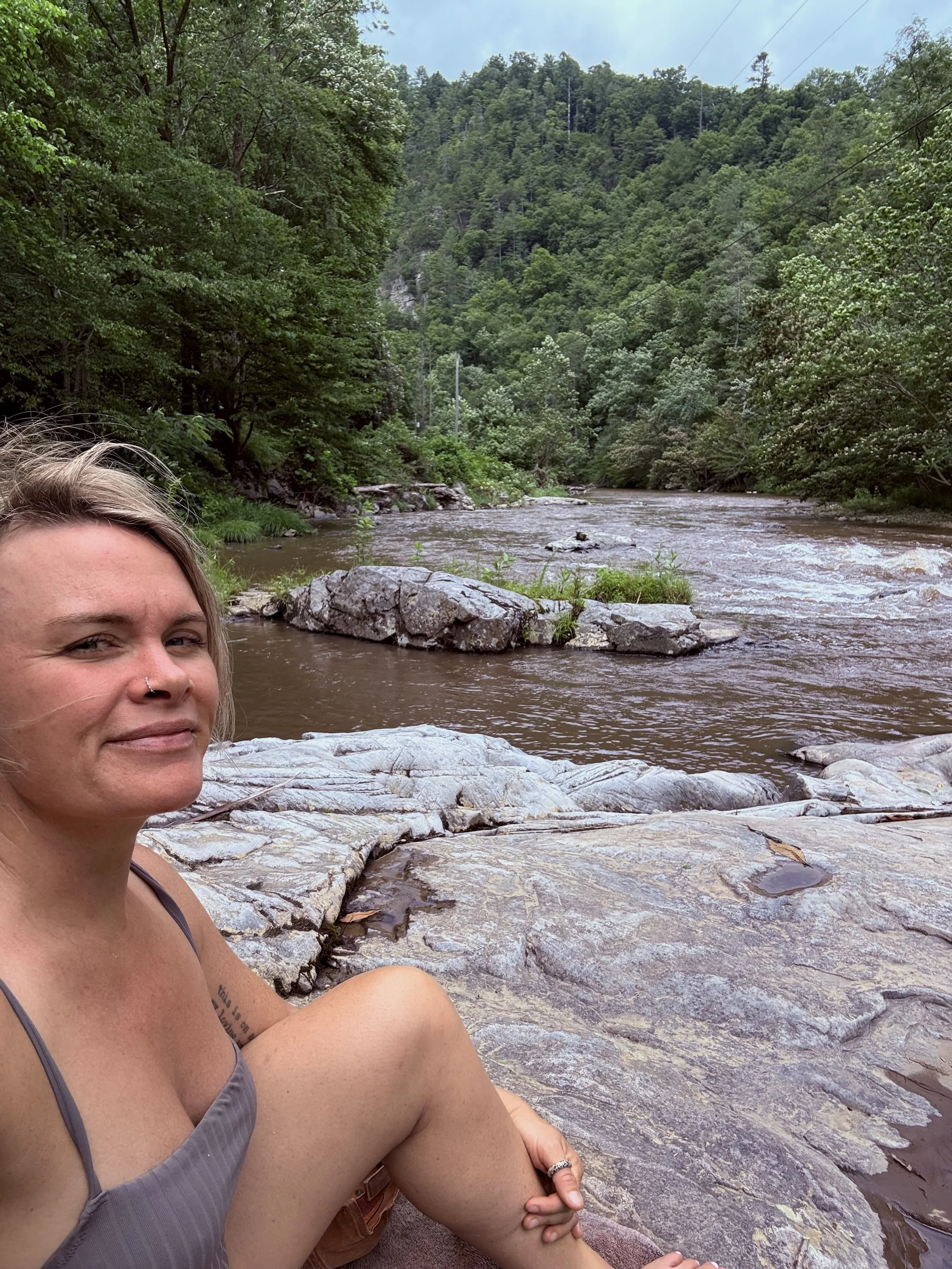
To the little girl.

A healer I work with occasionally asked me to address my inner child as “my little girl.” It’s softer, she said. More familiar.

By now, many of us understand the concept of the inner child—the part of us that holds old wounds, shapes how we move through the world, determines the love and validation we seek, and the gaps we try to fill. Tending to the unmet needs of that child is often the portal to the deepest kind of healing we can experience as adults.

My work is alongside children in the formation of those very wounds. My hope is to soften them—to create space for self-awareness and integration, rather than empty chasms sealed off by time and pain. No one moves through childhood without wounds; it’s impossible. They are no one’s fault. They are simply a byproduct of leaving the flawless plenitude of the womb and entering a world full of humans, each carrying their own stories and pain.

I think of this often at school. What stories are these children already beginning to carry? How do they see themselves? What needs are they asking to be met—especially through behaviors that appear disruptive or clingy? How can we help them grow emotional literacy and tools to navigate the hard things—not to avoid them, but to make sense of them? How can we honor who they are and how they exist in the world?

Essentially, how do we raise children who know themselves well enough that, when the sticky parts arise, they can meet those parts with love, compassion, and gentleness? So those parts become portals to their healing, too.

This idea of the inner child—my little girl in particular—has been heavy on my mind since last weekend. I canceled our camping trip at the last minute, following what felt like a wave of negative feedback on Friday. In truth, I may have latched onto that feedback to justify something I didn’t want to admit: that I was already mentally and physically depleted. That the idea of hauling gear into the woods to set up camp in the mud—especially as a single parent—felt like more than I could manage. Especially when my own girls are less than resilient in inclement weather these days.

There was also the familiar weight of feeling responsible for everyone’s experience, mixed with the disappointment of not being able to control the weather when I’d dreamed of a sunny weekend romping in the creek. And the potluck was unraveling—several families who’d signed up to bring food were waffling on coming at all.

None of it was huge on its own, but together it became heavy. The task of making a group decision while feeling unclear and overwhelmed tipped me over the edge, and canceling the trip felt like the simplest, most relieving choice. I had talked with the teachers, received their support, and felt good about my decision…

Until family after family messaged me to ask if they could still go. A deluge of texts reactivated all the anxiety I’d tried to quiet. Of course, I should have expected this. I wanted people to camp if they wanted to—I just didn’t want to feel responsible for it. And I didn’t want to go myself.

That’s a hard thing to admit when you’ve built your life and work around being a physically and emotionally resilient outdoor wanderer.

By Saturday afternoon, the messages kept coming. I found myself obsessively checking the weather, hoping for a downpour that would justify my decision, make me feel less guilty—less like I’d failed the community. But the skies cleared after a heavy morning rain. Families went out. More messages came. And I spiraled.

A friend offered reassurance: You made the best decision you could. It’s okay to choose rest. They were all things I knew to be true, and yet, none of them soothed me.

Because the part of me that was activated wasn’t rational. She was young. Tender. Emotional. She was the version of me who cried when she got 99% on a test because it wasn’t perfect. The one terrified of disappointing anyone, even a little, as if it meant she wasn’t allowed to exist. She felt responsible for other people’s happiness. And each message that hinted someone might be disappointed sent her into panic.

She didn’t need to be reassured she wasn’t wrong. She needed to feel the fear of being wrong—and let it move through her.

So I went into my closet and cried. For a long time.

Despite being a seemingly emotive person, crying is hard for me. I struggle to let go of control long enough to fully feel. I don’t want to make too much noise or disrupt anyone. I don’t want to be seen in my pain. But the closet under the stairs, dark and small, became a cocoon—safe enough to let the tears come. To give my little girl the space she needed. I howled and heaved and offered that girl just what she needed— my full attention, my willingness to sit with her, even in her fear that she was wrong, my love, my time. It wasn’t conditional; it was me showing up fully to be with her in that experience.

I still felt sensitive afterward, but I also felt settled, clearer.

As I sat with these feelings in my closet sanctuary, I found myself thinking about my own children—especially my eldest daughter—and how our most challenging relationships often become our greatest teachers. I kept thinking about the suggestion to call the inner child my little girl. I thought about my own little girls—my babies. Specifically Melby, who already seems to carry her own imprint of perfectionism and anxiety, intensity and fear.

Another thing that’s hard to admit as an educator—someone who has built a life around working with young children—is that my own children trigger the hell out of me. Especially Melby. She is a mirror of me in so many ways, and sometimes it’s so painful to look at that reflection.

And yet: she, too, is a portal to my healing. She is my little girl. A reflection of the wounded one inside me, and a living embodiment I can now love and tend and nurture into something more whole than I once was. When those more challenging parts show up in her—most often in direct reflection of ways in which I struggle too—how can I meet her with supreme kindness?

How can I say to her not that 99% is enough, but that even 1% is enough, as long as she is showing up fully as herself? That all I ask is authenticity. There is nothing to prove. I don’t want to convince her she’s enough; I want to assure her that being herself is all that’s required.

I want to repeat it again and again until she feels it in her bones and it ripples back through time, through her previously unborn body, into the little girl within me—so I feel it, too.

Being yourself is all that’s required.

As the year comes to a close, my deepest hope is that you’ve felt that here. That your children have felt seen and welcome, just as you are. That you have, as well.

On a walk shortly after my tears, Mary Oliver’s words came to me again, as they so often do: “You do not have to be good/ You do not have to walk on your knees/ For a hundred miles through the desert, repenting,/ You only have to let the soft animal of your body/ love what it loves.”

You do not have to be good.

The further I go on the journey of forest school, the clearer and more simple it all becomes: our work is simply to be ourselves—and, as educators, to create an environment in which it’s simplest for children to do just that. When we know ourselves, we can love. We can learn. We can grow. We can create boundaries. We can expand and stretch and connect and become.

Everything else is extra.

For all of your selves, for all of the comfort and discomfort and learning of this space, for this beautiful year together, for our animal bodies ever reminding us where we came from, for all the little ones—both those at school and those inside you, dear readers—I am so deeply grateful. Thank you, thank you.

On modern love.

One of my favorite poets/ contemporary authors, Joy Sullivan, offered a prompt to write about modern romance— any twist that felt appropriate. This piece is what came forth. It sits in clear contrast to my previous post, where I wrote about parting ways with this same person. And yet—here we are. Life is brief and blooming and strange. I won’t apologize for following joy when it calls, or for the occasional birdlike nature of my own heart—ever flitting about.

When I left the cocoon of my childhood home for college, I made a promise to myself: I wouldn’t touch alcohol in this lifetime—or a man's penis until I was married. Sobriety and virginity felt deeply important, shaped by the conservative values my parents had instilled in me.

Two decades later, I found myself unmarried, in a toxic relationship that had nonetheless gifted me two beautiful children, and regularly drinking too much to escape the ways I had learned to gaslight myself. I justified staying in a life that felt completely out of alignment, clinging to the belief that somehow, it was all my fault.

This year marks three years since I began choosing clarity. I started by quitting drinking, and then, in quick succession, I left my marriage. We had gotten married in what, in hindsight, was a last-ditch effort to salvage a relationship already beyond repair.

Leaving was monumental—especially after a lifetime of fawning over men. For as long as I can remember, I believed my worth was tethered to the approval and adoration of the opposite sex. In my twenties, I threw myself at the feet of men, hoping for praise, allowing them to touch me in ways that degraded and devalued me. Sometimes, they took what they wanted despite my protests. My now-ex-husband was one of the first to commit his attention and energy to me, and somehow, that—along with an adorable man-bun—blinded me to the ugliness beneath the surface of our “playfulness.”

After the birth of my two girls, something inside me began to shift. Every choice I made grew sharper, clearer. Instead of fumbling through life with a wobbly compass, I could now ask myself: Would I be proud to have my children repeat this choice? Could I explain it to them? Would it bring me joy to see them live in a similar way? This was its own kind of romance—pure, searingly clear.

When I asked myself if I’d be proud for them to emulate the relationship I had with their father, the answer was painfully obvious: no. This was not the version of love I wanted to model for my daughters.

After our separation, I embarked on a painful, radical journey of self-love. I began dating myself—not in the cocktails-and-roses kind of way I once imagined, but in the quiet, daily act of choosing myself over the comfort of old habits. I fumbled through therapy, medicine-work, solitude, journaling, meditation, inner-child work, Shamanic journeying. I cried. I cried so many tears I had once pressed beneath a heavy veneer of rage. I became softer.

Much of this work happened in a literal closet under the stairs—my own self-imposed Harry Potter quarters. I’d transformed that little story space in our tiny one-bedroom house into a little fairy nook for my girls, but also, for me, a sacred refuge for writing and journeying, praying and sobbing.

As a counterpoint to this quiet personal revolution, one of the most joyful—and still terrifying—parts of my unraveling has been learning to open, even just a little, in the presence of others. For a long time, I stood on the sidelines of ecstatic dance, both drawn to it and scared of what it might unlock. The idea of moving freely, without pretense, felt too vulnerable. Too naked. But eventually, I showed up. And then I kept showing up. Slowly, something in me began to thaw.

On that dance floor, I started to feel the edges of my aliveness again—not just the pain, but the joy, too. I let my body lead for once, not my fear or my mind. I showed up in presence, and motion, and feeling. And somewhere in that authenticity, I met a man—ten years my junior—who is now my boyfriend.

It’s not what I expected from this chapter of my life, or from my first real relationship post-marriage. Someone so young, so clearly in a different place in life. And yet, here he is: evolved, tender, gentle, receptive, and abundantly kind—so much my ex was not.

I don’t expect to be with him forever. He wants to travel, to have his own children, to live so much of the life I already lived prior to meeting him. And that’s part of what makes it so beautiful. For the first time in my life, I’m in a relationship where I don’t need anything from the other person. My biological clock isn't ticking. I’m not looking for financial support or a roommate to split the bills. I’m here for presence, for touch, for connection. There’s a deep freedom in loving without expectation or timeline.

He meets me in my softness. He listens. He sees me. He witnesses the daily things I’ve long called ugly and names the beauty in them. He has become a mirror for the goodness I so long prayed to find in someone else—only he’s shown it to me in myself. Loving him has become a portal into loving me.

This lifetime, I expect my greatest love story to be the one I create with myself, and other relationships have been a vehicle to developing that love. My ex-husband taught me to love myself by forcing me to advocate for myself—fiercely, even through discomfort and lies. My daughters taught me to love myself by clarifying my values and desires. And this man has taught me to love myself by loving me exactly as I am. Not a version of me, but the whole messy, wild, unfolding bundle I am becoming.

And our impermanence has allowed me to hold that lightly—not as an attachment to him, but as a gift to myself.

On one of my journeys, it came to me in this language: he is a delivery of love from the universe. Not one I’m meant to keep or cling to or ask anything of—not praise, not permanence, not a hand in marriage. He is love made manifest. And like all sacred gifts, he’s meant to be felt, embodied, and then released into the wind— to curl around other women in the breeze as they dance beachside, perhaps reeling, too, from their own journey of self-discovery.

This is the shape of modern romance, at least for me: not a contract, not a destination, not a cure, but a container for presence, a practice in being with what is, a celebration of love for love’s sake—without needing it to last forever to mean something. And in this wild, fleeting, luminous chapter, I am in love, not just with him, but with the way love has taught me to belong to myself.


on a moment.

 
This is not the picture or the moment, and yet it is. My wild girl, all her own.

This is not the picture or the moment, and yet it is. My wild girl, all her own.

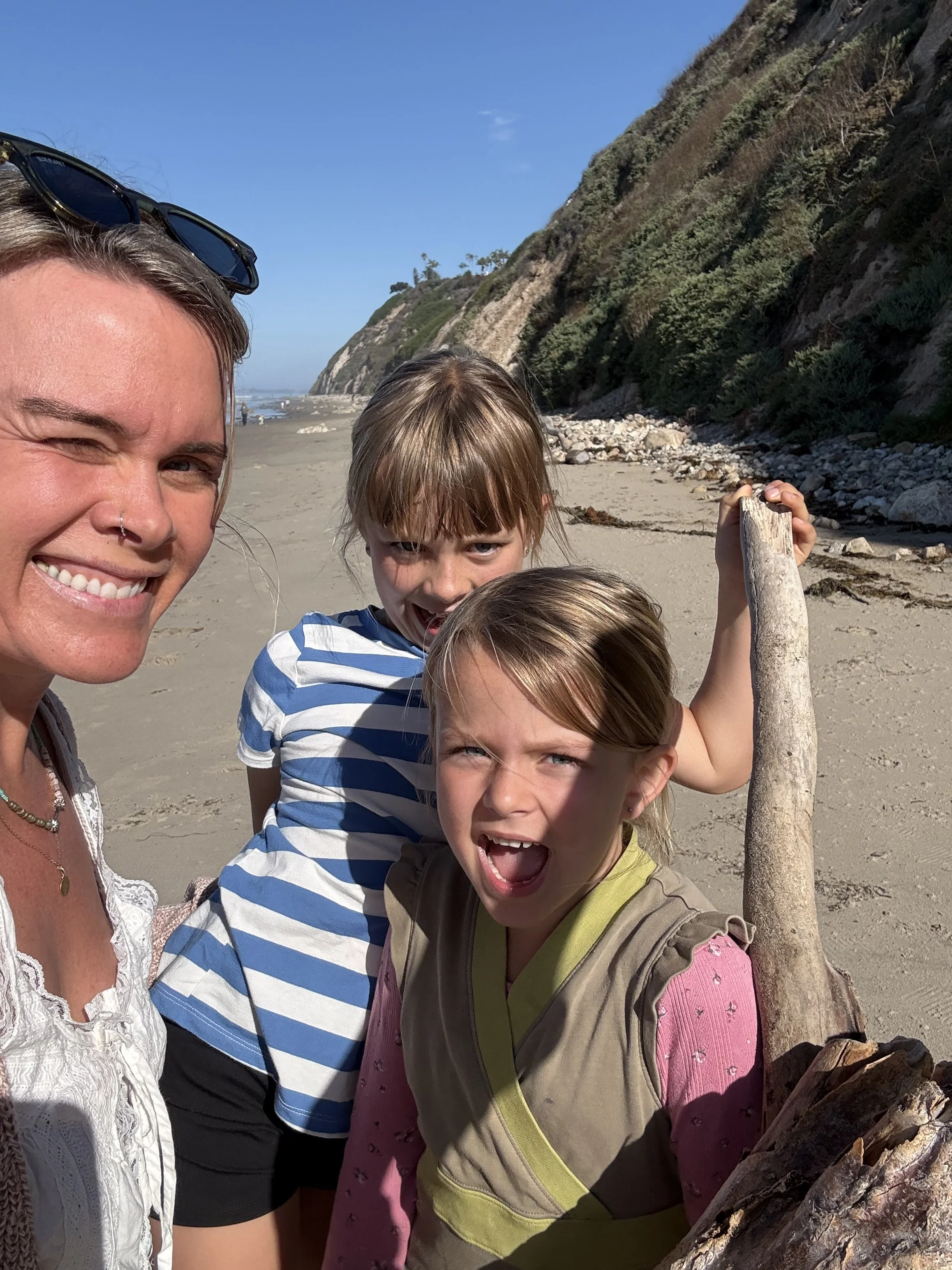
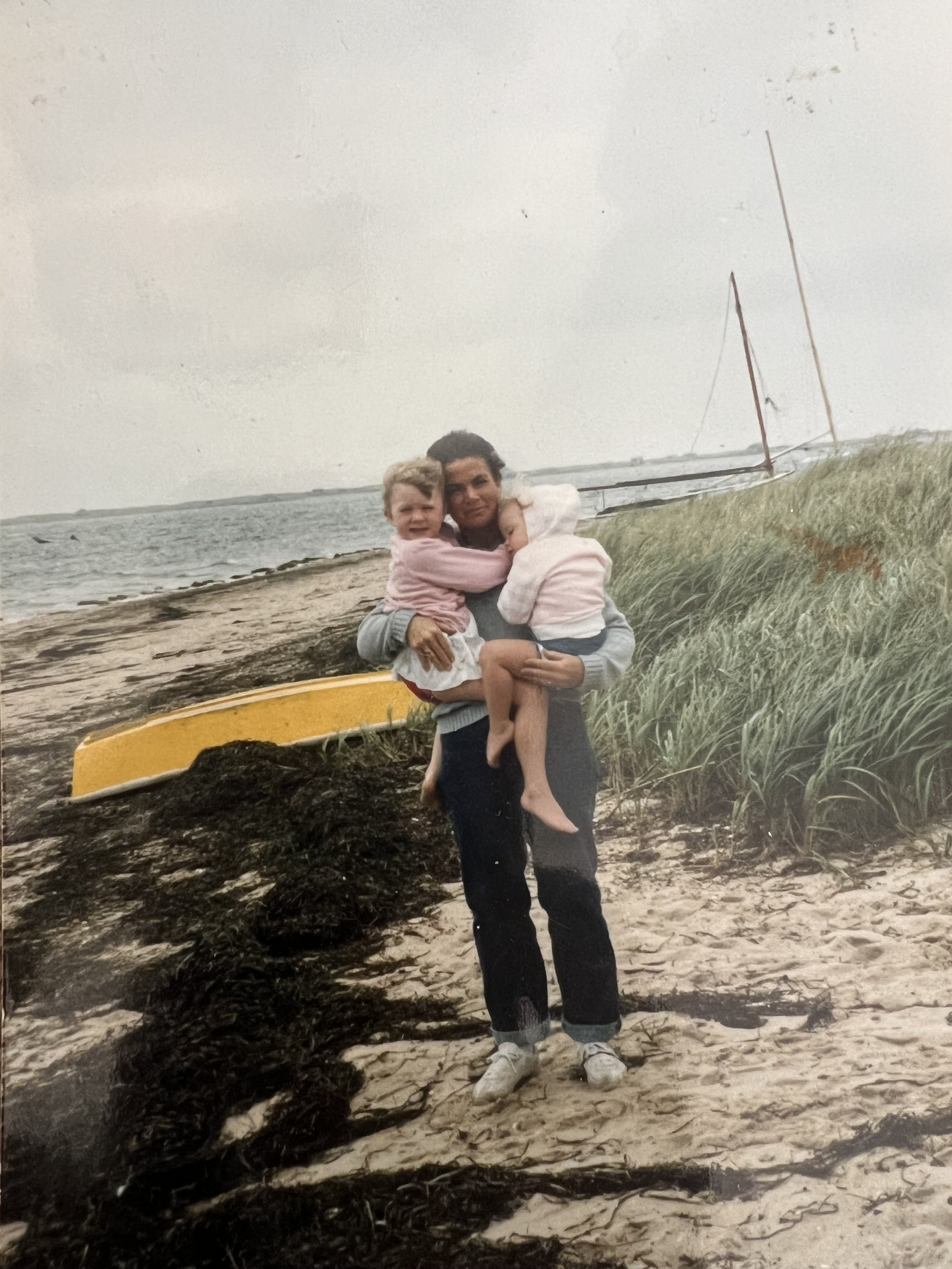
Watching Melby and the flickering bits of sun through my half-opened eyes feels like something between a memory and a dream. I rarely feel so relaxed as a mother, as I do now, lying horizontal in the warm morning sand, witnessing my girl dig in the quiet inlet to Hendry's beach. She is catching fish with a stick, wading in the shallow water, except the fish are bits of seaweed she carefully lays across the end of her stick and carries back to me, an offering at my feet.

Usually Melby insists I play in some particular fashion; more often she achieves whatever she thinks she wanted, only to ask for the next thing and then the next, but now, in this peaceful moment, she is content for me to lie watching her. I wonder, again, if I am calm for once because she is playing peacefully, or if she is playing peacefully for once, because I am calm.

And I'm sure, really, that both are true. There is no greater evidence of the complex interplay that is all relationships than the parent-child dynamic that can so quickly escalate to a place of stress and anger or so quickly return to something peaceful. Both parties are culpable and both are responding to the other's energetic output.

Over a month into quarantine, I wouldn't say I'm relaxed, but there is some element of suspended reality that allows me to feel slow in ways I don't normally feel slow. And that, in turn, I think has given Melby some peace too.

She is wearing an oversized red gingham swimsuit-- a hand-me-down from one of our generous older girlfriends. At this point, I can't remember what came from whom, but each new thing we uncover is a treasure, filled with even more meaning because it lived a life before now, it is filled with the wisdom of earlier 2 year olds. The suit puffs out around her torso, a little blue bow clipping it all together at her back. Her thighs are starting to tan and she has her first freckle on her right cheek. 

I feel both in awe of this girl and also slightly terrified by how much I love her. I still can't believe she came from my body, and suddenly it occurs to me that she no longer clamors to crawl back inside me. This revelation makes me want to crawl inside her somehow, to stay attached, feel what she feels, see what she sees.

Sagging with the strength of ocean breeze is a  wispy top-knot in her silky hair that doesn't tell the story of the tantrum that went along with it this morning, but I know. I think about it watching her. How I motioned to put a pony in for her, she screamed NO! and as I, choosing my battles, went to put the brush and hair ties away, she collapsed at my feet, immediately sobbing. I asked her to use her words and she unraveled. She wanted a pony but didn't want a pony but didn't want me to remove the option of the pony. 

I look at that tiny knot of hair and for a moment it is all the twists and challenges of motherhood in one-- not just fixing my child's problems, but giving her the space, the language, the ability to recognize them for herself. To name them. So they have less power over her. So she can call them out into the open and either ask for help in solving them or create her own solutions. But then also demonstrating and teaching compassion-- the ability to recognize someone else's challenges and help without being asked, to give freely.

Sometimes I get mired in the details. Everything I do right is some thing I am also doing wrong. Every line I draw I question. I just want to do right by my girl. And often the moments, the days even, are harder in creating a future I think is right for her.

I crane my neck to look at her more clearly, and she shouts, "Lie down, mama!"

She has started calling me "mom"; she must feel, somehow, how much it leaves me gaping, like the space between us is far too great. She is practicing her distance from me. But in this moment, she calls me mama. She is my baby, not a baby at all, and I listen. I lay back, grateful that today, all she wants from me is to be quiet and watch.

And what else do I have to do?

Watch this girl. She is now and she also, somehow, feels like a memory. She feels like forever.

I push my head back into the sand, and keep my eyes loosely tracking my small fisherman, the girl who grew inside me and is now growing me daily in always unanticipated ways. I feel an overwhelming urge to call her into my arms, to beg for a hug, to swallow her up, but just then she runs down the edge of the water, her arms spread out in the wind, her single stick acting as a divining rod for adventure.

She looks back and almost catches my eye, but then, keeps going. 


help.

Nic and I have been having the same argument for nearly six years. 

It unfolds in nominally different ways each time, but usually centers around my feeling that he needs to do more around the house/ give better input about meals or activities for the family/ offer me more positive feedback/ be more engaging/ plan dates/ pick up his shit/ something similar. 

I will begin the rest of this by saying, all those things are likely true. Nic's suitcase permanently exploding week-old boxer briefs and airplane packs of mixed nuts across the entryway of every house we've ever lived in is supremely annoying. He has a unique way of rapidly opening every cupboard and jar and making a huge mess in the time it takes me to go pee. He spends a majority of his time at home just looking at his phone; he will never ever ever initiate an out-of-the-house activity; he brings attention to my flaws and insecurities in a matter-of-fact way which I recognize is both only because I  am screaming about them, asking to be noticed, and which is done in a way that is impersonal above all else, if that makes sense. They are just words. But still none of the argument is actually about him.

Because the point is, he is not perfect; we have this same fight; and then at the end of it all, I realize that all I'm fighting about is the fact that I am supremely, totally bored.

I am bored. I am so bored I could just shrink up and die.

And the fact that Nic is not operating is some imagined perfect way is only me noticing how fucking bored I am and projecting it onto his actions.

I know that if I were not so bored, I would look at Nic's pile of chonies by the door and think Good God, this guy is messy and it is annoying af but I would NOT think Nic doesn't respect me or care about how much work I do around the house and this old pair of striped underwear is a direct affront to me as a person and I should probably scream at him until I'm hoarse.

If I had other things to flush out my idea of myself, my interests, my concept of how valuable I am, then the underwear wouldn't be quite so big a deal.

I have sort of known this for years. I have made zero changes to fix it, except I get to the realization a lot faster these days.

Two nights ago, I was moping around the house-- my state of being far, far, far too often these days, and when Nic tried to drag it out of me, whatever it is-- the sickness, the discontent, the source of my malaise, I said, almost immediately, "I just want to be interesting."

This is the point at which many well-meaning people tell me I just moved/ had a baby/ had a baby that last time I had a baby/ whatever other life changes excuse a person's not being knee-deep in new new jobs, recreational activities, and leisure interests. And they would be right.

But that doesn't matter, because if I didn't mind my current lifestyle— if I were content to be moving slow, figuring it out, adjusting— it would be one thing, but I most definitely mind.

I mind. I mind.

I am a horrible stay-at-home mom. I love my girls. I give them so much love; I make them good food; I keep my house clean; I plan fun activities; I create developmentally appropriate spaces and invitations to play; I love being with them. I am good at it on a superficial level. Except I am crawling out of my skin. I am just so motherfucking bored.

I feel like my brain is literally atrophying from not being engaged. I can't remember anything. I feel physically and emotionally unmotivated. I am constantly exhausted.

It's not a baby. It is a spiritual crisis.

I need to get started. I need whatever it is that lights a fire under my ass and inspires me to write or move or dance or plant or grow or whatever else. I need that cascade. I need the energy of movement that begets movement.

Certainly I would like a job at some point. Certainly we need income. But I don't just want something to pass the time. I want something that ignites me. 

And I have literally no idea what that is.

I feel embarrassed writing this in some regard and also, it is so totally me that I feel also assured in doing it. The way I find the resources I need is often by these sweeping appeals. People feel connected to me, to my often blatant misery or lostness, to my self-criticism, my flaws, my worries. People like me, because I am willing to like and listen to them, because I can see a part of myself in literally anyone. And so I often find what I need where I don't expect it. Or, I guess, exactly where I do.

Before I make my big request, that also bears mentioning.

I moved cross country with a newborn and a very demanding 2 year old and I have to say: I did it because people helped me. People came out of the woodwork to hold my kids or take them on walks or to the zoo. An old coworker I hadn't seen in maybe a year or more came to literally pick up a truckload of trash from the alleyway behind my house. So many people brought me food. And wine. And food. People showed up at my house early on a Saturday and helped me pack all my shit away in wooden boxes bound for California. People listened to me rant and constantly asked how I was and gave my heart space and my body space.

I still fell the fuck apart. I was so frazzled and anxious. But I made it here, regardless, and I made it because people helped me and they helped me because I asked and even when I didn't ask overtly, I did with my desperation.

So before I ask for more, thank you. Thank you for being a person, who reads these words and finds some commonality or maybe also just gawks at how transparent/ verbose/ trivial/ whatever I am. If you read the words, I know it's because you relate, somehow. If you take time to be here, it's because you are also me, somehow, and that is true whether you feel solace or judgment in response. Thank you for being that person, either way, because it makes me feel alive. Thank you for being a person, maybe, who offers to help, who says something, who comments, who is part of this. Because what I need, ultimately, is to feel not alone. I need to feel connected, to myself, to the earth, to the people around me, and every bit of that that I get helps. It makes me less bored. It elicits that firing of neurons that makes me someone alive, now, in this world. It makes me human.

That was my aside to say, thank you for being human with me. That is the one thing that happens semi-regularly that makes me feel alive in the exact way I am seeking.

And now, for my request. I need help.

I need to do something. And I don't know what it is.

I'm not asking for a job. I'm not asking to pass the time. I'm asking to move/ do/ learn/ be/ grow/ start. I am a firm believer in the cascade-- how you begin one thing and it can snowball into something lovely you never anticipated. I wish I knew what I were asking for. To kayak with you? To go on a backpacking trip? For you to teach me to knit? To volunteer with you? To have a job in your cafe? To do the writing for your blog? To draw the cartoons for your yoga teacher manual? (This one I've actually done...) I don't know what it is! I don't know what it is. But if there's a spot in your life that needs filling, or maybe even just a spot that has space somewhere near you, consider me.

I wish that could happen organically. But I have gotten too far away from it. I've thought too much and sat too long and fretted too much and now I'm sitting here with nails chewed down to the quick and a raging case of anxiety and what I need a spiritual awakening. 

I hope you understand when I say that. I think many people won't. I think whomever I'm hoping to reach with this will.

Everyone else is walking around summarizing their years in hopeful or resigned words, and all I can think is, whether tomorrow is the first of the year or a debatable decade or just a random Tuesday, I have got to switch shit up. I am dying inside. I feel like a polar bear trying to live in the Sahara. I feel like a butterfly trying to carry a piano. I am just not living right. I am not living who and how I’m supposed to be. I am fighting it and fighting it and have gone so long not doing or being whatever I’m supposed to do or be that I can’t even see straight. I need help.

And I will reiterate, again, this isn't about a job. I'm afraid people will respond and try to get me to do remote clerical work for them.

This is not that. 

Though I'm not sure exactly what it is.

All I know is, I keep saying that I'm lost here. 

But I'm not really. What I am is stripped bare enough of my routines and daily noise to step back and pay attention to how done I am with the life I've been living. 

When whatever transformation comes that I've been waiting for, I honestly don't think I'll look any different. I'll probably still live here. I might still be a stay-at-home mom. Maybe I still won't make any money. But I won't be bored. I won't have to pick the fight. Because I will feel all the ways in which I am valuable and interesting and engaged because I will be living them.

I just have to find out where to start.

If you know, if you know at all, please tell me.

And in the meantime, sorry Nic, for yelling at you about the underwear. It’s not about the underwear.

But also, please, pick them up.