On coming home.
As I took in the expanse of the hills of western North Carolina—so lush and rolling and impossibly green—I began to sob uncontrollably.
I was driving to a regenerative land sanctuary, where my dear friend Val's fiancé was hosting a bluegrass concert in an old tobacco barn, and the next day, their wedding at the same site.
I hadn't seen Val in over six years, and hadn't spent more than a day or two in her presence in nearly twelve. For years we'd worked together at the same German restaurant in San Francisco, stumbling through our twenties with parallel stories of floundering, heartbreak, discovery, and reinvention.
When I saw her on the porch of her little home, surrounded by trees and lightning bugs and loved ones as a summer storm rolled through, I was struck by how at home she seemed in herself.
She was barefoot in tiny shorts and a crop top, gathering bowls of salad, ears of corn, and platters of grilled burgers, tucking them beneath the eaves as the rain came in. There was nothing performative about it. She moved with an ease that made everything around her feel cared for without ever seeming managed. She was equal parts wild woman and gentle nurturer, organized and maternal without losing any of the freedom I'd always associated with her.
Watching her, I had the strange feeling that I had known this version of her years before either of us had actually met her. It wasn't that she'd become someone different. She was still unmistakably Val. But somewhere along the way she'd nestled into herself. She seemed more completely herself than I had ever known her to be.
That image stayed with me as I drove through the mountains, crying for reasons I couldn't yet explain.
A surprising part of arriving on that side of the country after so many years away from Kentucky was how quickly scent reached something memory couldn't.
It was the smell of saturated earth. Warm rain. Air conditioning humming in old houses. The electric heaviness that settles before a thunderstorm. I can't quite describe it except to say it felt like some exchange of moisture between sky and body and earth. I hadn't realized how much I missed it.
It brought to me, viscerally, the memory of another porch. It belonged to the tiny, haggard house Nic and I first rented in Kentucky. The place was objectively disgusting when we moved in, and yet somehow we made the sweetest home there. People always wanted to come. We'd make biscuits and bacon gravy in the mornings and carry our plates outside to those cracked little concrete steps, drinking coffee and eating in the humid air while the neighborhood slowly came to life. We'd spend whole summer evenings out there, talking while thunderstorms rolled in.
The porch was hardly a porch at all, and yet it became the place where life happened.
Looking back now, it feels less like the entrance to a house than a foothold. A little anchor. The first place Nic and I learned to make a home together. We took so many of our maternity photos there— me in overalls, him in a polo shirt, both of us laughing, in love.
I love California with the deepest parts of my heart—its chaparral, its oaks, its dusty, woody greens—but this was something different. Looking out over endless miles of impossibly green forest, I felt something ancient in me awaken. My first instinct was to walk into the trees and disappear. Not in suffering, but in surrender. Not because I wanted to leave my life, but because I wanted, for just a moment, to stop carrying myself. To remind myself that I belong to the earth, and that at my simplest I would gladly be reabsorbed into it.
Whenever anyone asked how the trip was, I'd answer, "It's so green."
I don't think they understood that I wasn't just describing the landscape. I was describing relief, livelihood, connection, memory, timelessness. My body remembering something older than language.
There was a tumble of memory. Of the life I leapt into in Kentucky without looking. A life of tumultuous romance and creating homes and giving birth and beginning a journey that somehow became both healing and self-destruction through an obsession with health.
On the plane to North Carolina, I listened to a recording by a healer I deeply admire. At one point he guided everyone to imagine walking through a golden door and meeting a future version of themselves—someone more expanded, more healed, more evolved. I've met her before. She looks just like me, but softer.
We were invited to receive a message from this future self. I found myself craving something elaborate, some profound wisdom or secret pathway toward becoming her.
Instead, she gently pulled me to the ground. She rubbed my back. She stroked my hair. She covered the places that hurt with mud. She said only one thing: rest.
I kept waiting for more.
Rest.
I asked again.
Rest. Her voice a gentle hush. Not an admonition, but an insistence. Only rest.
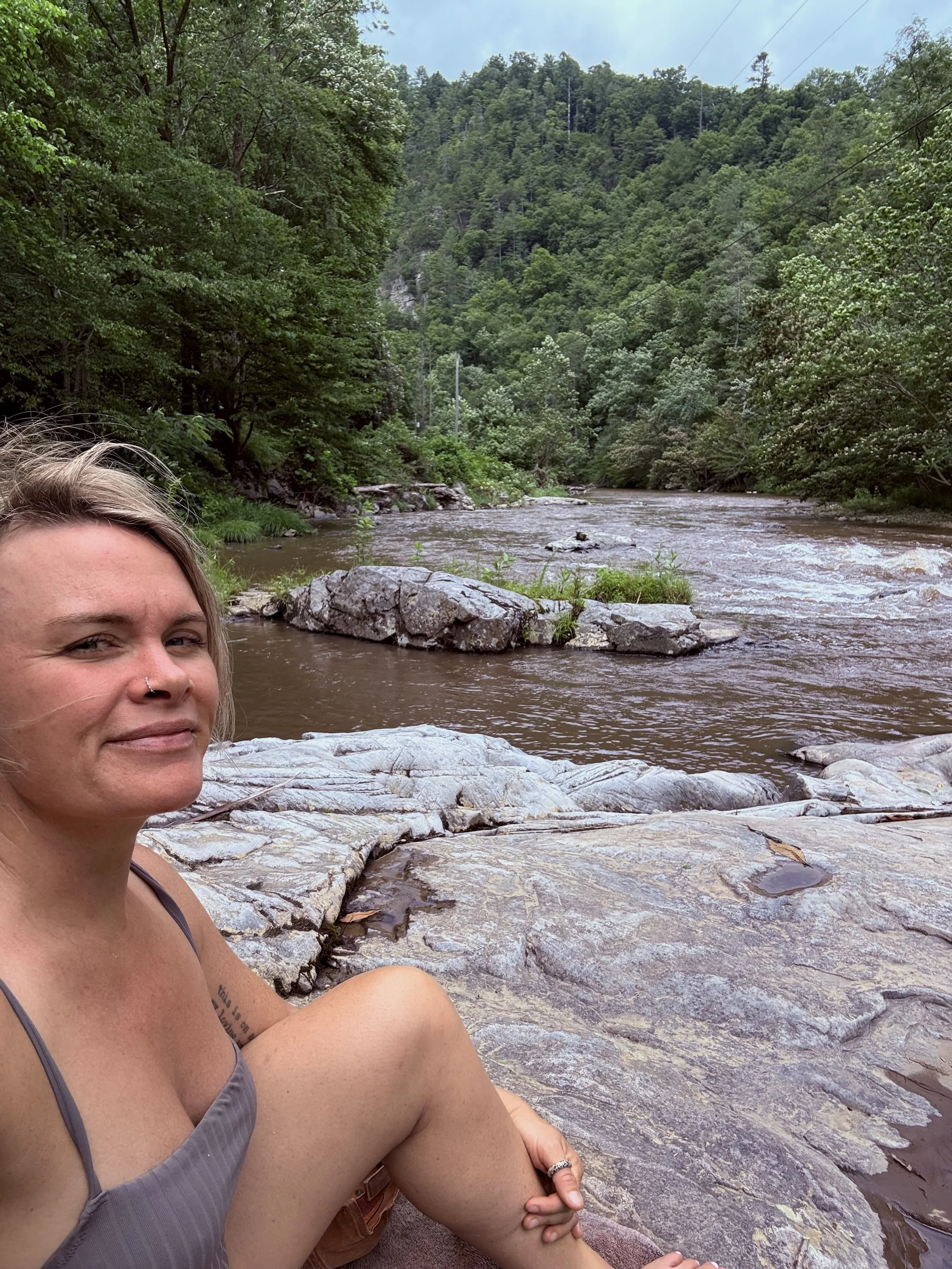
The first full day I had in North Carolina was almost entirely my own. I drove out to the Laurel River, hiked for a mile or so, and settled onto a flat rock in the rushing water. I ate a sandwich and a peach, then I just lay there for hours. I didn't read or journal or meditate. I simply watched the sun appear and disappear behind fast-moving clouds and occasionally drifted to sleep.
I'd done almost exactly the same thing the week before while camping alone for a night at Paradise Road. I spent the day beside the river and the evening in a hammock watching the stars come out. Normally I would have read or hiked or made a nature mandala or written letters or journaled. Instead, I simply rested.
Something low and ancient in my body had already begun repeating the same message my future self gave me.
Rest.
For me, rest looks like no input. No conversation, no pondering, no processing, no learning, no doing. Just full surrender. The energetic equivalent of being reabsorbed into the trees.
I have been healing for so long. Learning. Optimizing. Changing. Growing. Researching. Fixing. I've been in transition for years. I've been becoming.
And something about this season, and this message, felt unmistakably clear: enough.
I am not done growing. I know I never will be. But I remember something from college: you can only study for so long before you have to stop and let your mind absorb what it's taken in. Integration is part of learning. Certainly it is part of healing, too.
Around the same time, another part of me was reaching its own limit. For years I've struggled with relentless digestive issues, eventually discovering that an overgrowth of bacteria in my small intestine was likely responsible for much of it. I had already completed one aggressive course of treatment and a hyper restrictive diet afterwards— which failed completely. My numbers were worse afterward than before.
So I tried again.
This time the protocol was even more aggressive. By the time I arrived in North Carolina, I was taking handfuls of antimicrobials every day and, quite frankly, shitting my brains out. It didn't feel like healing anymore. It felt like destruction. I know my body well enough now to distinguish catharsis from suffering. This wasn't some necessary purging. It was a fire that I kept feeding because everything we're fed says more effort equals more healing.
My naturopath suggested reducing the dose. Instead, I stopped. Rest, my body said.
A few days after I returned home, I saw a new acupuncturist. Without knowing anything about my visualization, my afternoon beside the river, or the message that had been echoing through my body for weeks, he kept returning to the same observation.
"You are healthy." My organs. My skin. My nervous system. My awareness. Again and again, he reflected health back to me. His strongest recommendation wasn't another supplement or another protocol. It was to stop most of what I was taking, keep only a couple of things for support, and begin telling myself that I am well.
For most of my life, I have believed the opposite.
I have felt broken, wounded, unwanted, unimportant, unlovable. I have treated myself accordingly. I have treated myself like something to fix, like a problem to be solved. I have worked incredibly hard to become well.
Rest.
I'm not done, but I'm done for now. I'm done optimizing, done striving, done fixing. I no longer need to fix my body or my mind. I need to nourish them. To add in instead of take away. To revel. To enjoy. To create space.
It isn't lost on me that this revelation arrived at the very same time we physically moved into a new home.
We now have twice the space we did before. My own bedroom. A little yard with a glorious pink trumpet tree we've named Sylvie. We've turned the couch toward the large picture window that frames her and jokingly call it our big screen TV, always tuned to the nature channel. The girls wake early and curl up with Babysitters Club books on the couch or in the hammock swing while I pad across the old painted vinyl floors making Dutch babies for breakfast.
Something about living here feels like an exhale.
After more than a decade of living in other people's homes, in other people's energy, collapsing beneath the intensity of other people's needs and chaos, I suddenly feel like I can fully inhabit my own space.
The first time Nic dropped the girls off here, he wandered through the house for a while before saying the house reminded him of Audubon. I laughed because he was exactly right. The painted floors. The little porch. The Dutch door opening onto the yard. The slightly crooked charm of a house that's lived many lives.
There was something I couldn't quite name in that moment— the person I'd built my first home with, standing in the threshold of this one, recognizing something in it before I had. And alongside it, something quieter, a pride I hadn't expected. Because this home is mine. Not ours, not borrowed, not shaped around someone else's life. Mine.
But I don't think it was really the architecture he recognized; it was the feeling. It's a collection of imperfect rooms that someone had loved into beauty.
And almost immediately I realized that's what I've been trying to do with myself. I have lived many lives. I am imperfect. I have been wounded. There are places that have broken open more than once. I've patched them and painted them. I've opened the windows and made another meal. I've Invited people in again.
Maybe that has always been the work. Not fixing, but making a home. Not becoming someone else, but learning to inhabit the person who is already here.
There will always be seasons of repair. Roofs to patch. Paint to refresh. Gardens to tend. Bodies asking for attention. But there are also seasons for reading on the porch.
The other afternoon the girls came home from camp, each grabbed a book, and headed straight outside. There's almost nothing out there yet besides our fairy garden and a strange wool rug covered in fish. They leaned against the wall beneath the front window where, in the middle of the day, the sun warms your legs but leaves your face in shade.
I felt that familiar urge toward productivity, but instead, I followed their lead. I lay down on the concrete beside them and opened my own book. Rest.
I've thought a lot about those tears that surprised me on the drive through North Carolina. At first I thought they were about nostalgia. Then I thought they were about Kentucky. Or Val. Or the smell of summer storms.
I don't think they were.
I think they were tears of recognition. Recognition of the young woman making a home on broken concrete steps in Kentucky, recognition of my dear friend becoming more fully herself over the course of twelve years, recognition of my own body remembering a landscape before my mind did, recognition that healing isn't always another protocol, another insight, another thing to fix, recognition that this radiant future self I’m longing to be is actually who I already am now. Sometimes it's inhabiting the life you've already built. Sometimes it's trusting that the home you've been searching for isn't waiting somewhere else.
It's waiting for you to finally come inside. Or perhaps to go outside. To settle, wherever you are.
I've spent so much of my life believing that wellness was something to earn, that belonging was something to achieve. If I could just heal enough, learn enough, work hard enough, change enough, become enough, then perhaps I would finally arrive.
But what that endless expanse of green trees shook my soul into remembering is that there is nothing to prove.
The trees aren't proving themselves. The river isn't proving itself. No one is angry at a seedling for being a seedling. It is simply doing what living things do.
I don't think we're meant to be any different. Healing isn't becoming someone else. It is learning to rest in exactly who I am, and perhaps who I have always been. Every version of me has been me. Every version has belonged.
Outside my window, as I write this, Sylvie bobs in the summer wind, framed by our big screen TV. She doesn't hurry herself toward bloom, or apologize for the ocean of dead leaves she's cast off. She simply responds to the life she's been given— at home in herself. And I am at home watching her. Everything in its place. Everything belonging. Maybe that is what rest actually is.